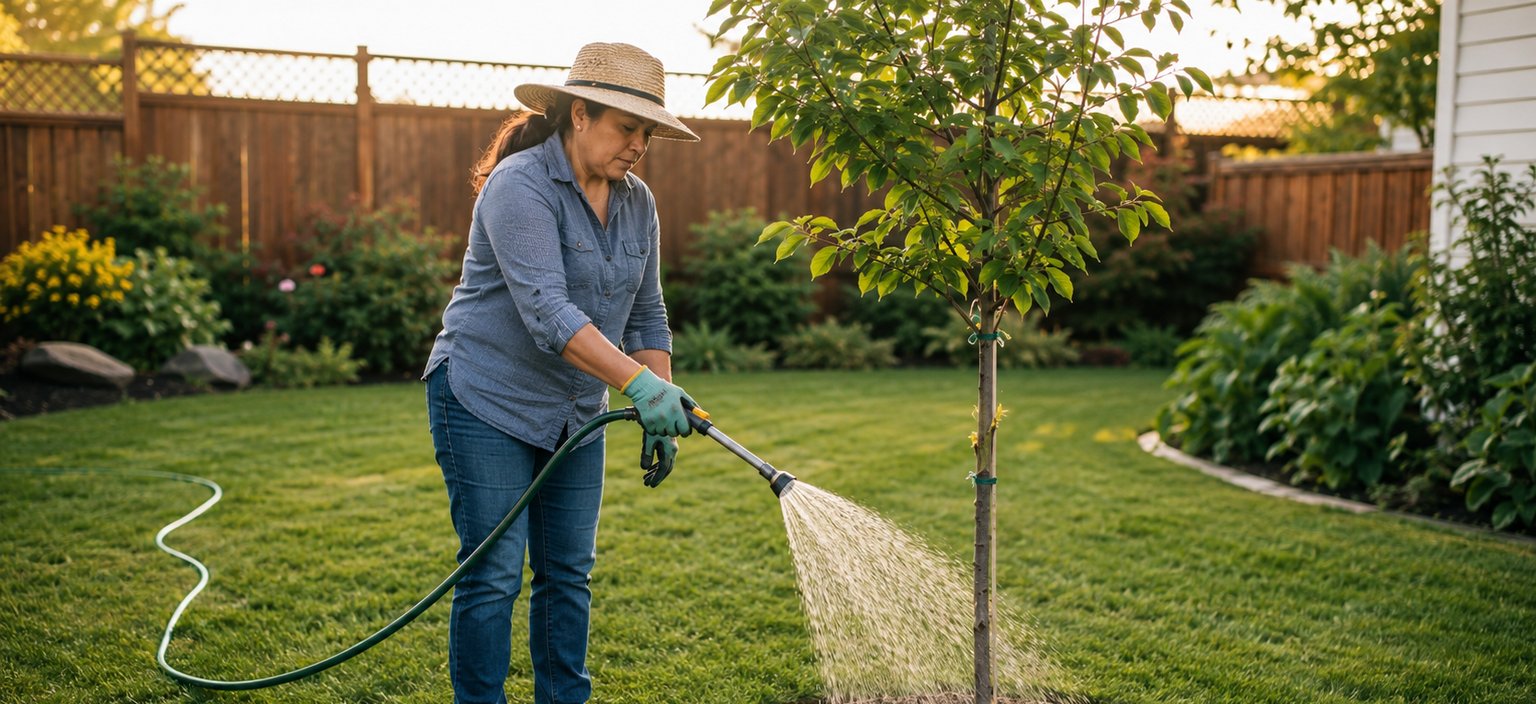
The most common irrigation mistake in Tuscaloosa is not watering too little. It is watering a little bit every day.
What Alabama Extension actually recommends
From Home Lawn Maintenance:
Apply about one-half to one inch of water, which will moisten the soil to a depth of 4 to 6 inches. Never water a lawn every day except during the establishment phase or renovation. Frequent watering only encourages shallow rooting.
Weekly totals come from Extension’s species guides:
- Bermudagrass: 1 to 1.25 inches per week on a recurring basis, more during persistent drought
- Zoysiagrass: about one inch of supplemental irrigation during periods of no rainfall
- Centipedegrass: about one inch per week to maintain attractive color
- St. Augustinegrass: roughly half an inch per application, watered early while dew is still on the lawn
So: roughly an inch a week, delivered in one or two soakings, not seven sprinkles.
Why deep and infrequent works
Roots grow toward water. Water the top inch of soil every evening and roots have no reason to go deeper than an inch. That lawn is completely dependent on you — miss three days in August and it browns.
Water to 4 to 6 inches once or twice a week and roots follow. That lawn has a buffer. It survives a missed week, a broken timer, a vacation.
Extension’s exception is establishment. New sod or sprigs do get daily water — St. Augustine wants daily irrigation for at least two weeks after planting, and newly sodded centipede gets about half an inch per irrigation daily the first week, then only as needed. That is a temporary phase, and it is where a lot of people form a daily-watering habit they never break.
Morning, not evening
Extension: “The best time of the day to irrigate or water is early in the morning because it minimizes the potential for water loss through evaporation.” Their south Alabama calendar narrows it to 6:00 a.m. to 10:00 a.m.
Evening watering leaves the canopy wet overnight. In Tuscaloosa’s humidity that is a standing invitation to fungal disease — brown patch, large patch, dollar spot all favor extended leaf wetness.
Calibrating, which takes ten minutes once
You cannot manage an inch of water if you do not know what an inch looks like from your system. Extension’s method, verbatim:
Scatter a few shallow empty cans, such as from canned chicken or tuna, around the irrigated area to measure the length of time your system takes to apply one-half to one inch of water.
Run the zone, time it, measure the depth in the cans, average them. Now you know your zone puts down, say, half an inch in 22 minutes. You are done guessing forever.
The scattered cans also reveal coverage problems — if one can has twice what another does, you have a head or pressure issue that no amount of run time fixes.
The Tuscaloosa wrinkle: the fall dry spell
Tuscaloosa averages 52.60 inches of rain a year, which sounds like a lot. The problem is when it falls.
Using NOAA 1991 to 2020 normals for Tuscaloosa Municipal Airport, the three driest months are August (3.30 in.), September (3.52 in.) and October (3.51 in.). The wettest are November through February — 5.08, 4.62, 5.35 and 5.32 inches — when warm-season turf is dormant and indifferent.
That inversion is the local story. Rainfall bottoms out exactly when the lawn is still actively growing, still hot, and heading into fall pre-emergent and armyworm season. Irrigation demand in Tuscaloosa peaks in late summer and early fall, not midsummer, and a lot of people mentally check out of lawn care right as it matters most.
Runoff on sloped lots
Much of Tuscaloosa County sits in the Fall Line Hills, where the Geological Survey of Alabama notes topography can be fairly rugged with steep slopes occurring near streams. Coastal Plain soils here are typically sandy over a clayey subsoil.
On a slope, a long single run produces runoff — water leaving before it soaks in. The fix is cycle-and-soak: split the run into two or three shorter cycles with 30 to 60 minutes between them. Same total volume, all of it absorbed.
Are there watering restrictions in Tuscaloosa?
Not on a standing, year-round basis, as far as published city material shows.
Tuscaloosa adopted a five-stage drought contingency policy in 2017. Stage 1 triggers when Lake Tuscaloosa drops 11 feet below pool level, and the Stage 1 response is a request for voluntary conservation. At adoption, city officials noted that a drought severe enough to trigger it would be several times worse than anything on record, and that the plan was more likely to be activated by infrastructure failure than by weather.
The city has issued temporary orders before — in June 2021 a conservation order restricted non-essential water use for customers south of the Black Warrior River, then expired.
The current City of Tuscaloosa water pages do not publish drought stages or watering rules. Check the city’s water page for any active order before assuming, and treat any article listing specific odd/even watering days for Tuscaloosa with suspicion — that text is not published anywhere we could find.
Signs you are getting it wrong
Underwatered: footprints stay visible after you walk across, blades fold along the midrib, color goes blue-grey before it goes brown.
Overwatered: spongy underfoot, mushrooms, algae or moss in low spots, recurring fungal patches, shallow roots you can peel up like carpet.
Just right: the lawn goes a week between waterings in summer without complaint, and a screwdriver pushes into the soil easily to four inches the day after you water.
Quick reference
- One inch per week total, from rain plus irrigation
- One or two applications, never daily except on new sod
- Early morning, ideally 6 to 10 a.m.
- Wet the soil 4 to 6 inches deep
- Calibrate with tuna cans once and stop guessing
- Cycle and soak on slopes
- Expect the heaviest demand August through October, not July
Leave a Reply