Author: admin

  • Soil Testing in Tuscaloosa County: Costs & How-To

    Soil Testing in Tuscaloosa County: Costs & How-To

    Almost every fertilizer decision on a Tuscaloosa lawn is a guess until you have a soil test. It costs about ten dollars, takes a few days, and is the only way to know whether your lawn needs lime, phosphorus, potassium — or nothing at all.

    Why it matters more here than in most places

    Soils across most of Tuscaloosa County are naturally acidic and low in nutrients.

    The county straddles two physiographic regions. Per the Geological Survey of Alabama, the northern and eastern parts sit in the Warrior Basin District of the Cumberland Plateau, underlain by sandstone, shale and coal. The rest lies in the Fall Line Hills District of the East Gulf Coastal Plain, where the Pottsville Formation dips below the sands and gravels of the Coker Formation.

    What that means practically, per Alabama Extension:

    Both halves of the county trend acidic. Most warm-season turf wants pH 6.0 to 6.5 — centipede is the exception, preferring around 5.5 and tolerating 5.0 to 6.0. So the typical Tuscaloosa lawn is sitting below where its grass wants to be, and lime is frequently the highest-value input you can apply.

    One correction worth making: Tuscaloosa County is not in the Blackland Prairie. The Black Belt lies south of here — Greene, Hale, Marengo, Sumter, Perry and Dallas counties. If you have read that Tuscaloosa lawns sit on alkaline chalk soils, that is someone confusing the two regions.

    Where to send it

    Alabama Extension routes samples to the Auburn University Soil, Forage and Water Testing Laboratory.

    • Address: ALFA Building, 961 S. Donahue Drive, Auburn University, AL 36849-5411
    • Phone: (334) 844-3958
    • What routine analysis covers: pH, phosphorus, potassium, magnesium and calcium
    • Fee: $10 per sample as of the 2022 fee schedule — confirm current pricing with the lab before mailing, since we could not find a newer published schedule
    • Turnaround: Extension’s page says a report is emailed or mailed within one to two days of the lab receiving samples; the submission form says three to seven days

    Samples now need to be logged into the lab’s online system before submission, so start at the lab’s website rather than just putting a box in the mail.

    Locally, the Tuscaloosa County Extension Office is at 1800 McFarland Blvd E #342, Tuscaloosa, AL 35404, (205) 349-4630, open 8:00 to 4:30. Call ahead to ask whether they stock sample boxes — the county page does not list that service either way.

    How to take the sample

    This is where people go wrong, and a bad sample produces a confidently wrong report.

    Depth matters, and lawns are different from gardens. The official form specifies: for established pastures, hayfields and lawns, sample the top 2 to 3 inches. Cultivated areas go 6 to 8 inches. Sampling a lawn at garden depth dilutes the result with subsoil and understates your lime need.

    Composite it. Each sample should be a mixture of subsamples from at least ten different spots in the area. One core from one corner tells you about one corner.

    Send enough. One pint, which is two cups, about 450 grams.

    Sample problem areas separately. If one section of the yard is chronically thin or off-color, that gets its own bag and its own label. Mixing it into the general sample averages away the very thing you are trying to diagnose.

    Skip the odd spots. Do not sample where the dog goes, where fertilizer spilled, along a concrete edge — lime leaching from concrete raises pH locally — or in a low spot that stays wet.

    Reading the results

    The report gives you pH, a lime requirement, and levels for phosphorus, potassium, calcium, magnesium and some micronutrients.

    The one thing it will not tell you is your nitrogen requirement. Extension is explicit that soil tests “cannot reliably evaluate the nitrogen requirements for a lawn.” Nitrogen comes from the species table, not the lab:

    GrassStandard lb N per 1,000 sq ft per yearMaximum
    Bermudagrass35
    St. Augustinegrass24
    Zoysiagrass23
    Centipedegrass12

    Never more than one pound of nitrogen per 1,000 square feet in a single application.

    On lime: apply what the report calls for, and apply it in winter. Lime moves slowly through soil and takes months to shift pH. December through February is the natural window, which is one reason a winter soil test fits the calendar so well.

    On centipede specifically: do not correct its pH up to 6.5 out of habit. Centipede is adapted to acidic soil and over-liming it causes problems.

    How often

    Extension recommends testing annually to build the initial plan, then retesting every two to three years once you have a baseline.

    If you have a history of spring dead spot in bermuda, pH is worth watching more closely — Extension’s publication on it recommends maintaining soil pH between 5.8 and 6.2 and notes that neutral soil pH is among the predisposing factors.

    Quick reference

    • Sample the top 2 to 3 inches for lawns, not 6 to 8
    • Composite at least ten subsamples per area
    • Send one pint per sample
    • Bag problem areas separately
    • Log samples in the lab’s online system first
    • Test in winter so lime has time to work before green-up
    • The report will not tell you your nitrogen rate; use the species table
  • Pre-Emergent Timing West Alabama: September Guide

    Pre-Emergent Timing West Alabama: September Guide

    Every February, Tuscaloosa lawns fill up with henbit and annual bluegrass, and every February people go looking for something to spray. By then the fight is already lost. The application that would have prevented it was due the previous September.

    Pre-emergent herbicide does not kill existing weeds. It establishes a chemical barrier in the top layer of soil that stops germinating seedlings. Timing is the entire product.

    What Alabama Extension actually says

    This matters, because a great deal of internet lawn advice attributes a soil-temperature rule to Extension services that Alabama Extension does not publish.

    Alabama Extension gives calendar dates, not soil temperatures. Across their fall and winter lawn care guidance, their monthly gardener’s calendars, and IPM-0590 on chemical weed control, the guidance is by month:

    • Fall, for winter and spring weeds: “apply them in mid-September or early October for the best results”
    • September calendar: if winter or spring weeds were a concern this year, apply pre-emergent
    • October calendar: same instruction repeated
    • February: “Apply preemergent herbicides if forgotten in September and if spring weeds were a concern last year”

    So the primary window in Alabama is mid-September to early October, with February as the backup.

    The soil temperature rule, correctly attributed

    The familiar “spray before soil hits 55 degrees” guidance is real and useful — it just comes from Georgia and South Carolina, not Auburn.

    • UGA Extension B978: apply for summer annuals such as crabgrass and goosegrass prior to soil temperatures reaching 55 degrees. For winter annuals, apply when nighttime temperatures drop to 65 to 70 degrees.
    • UGA’s climate blog notes crabgrass germinates around 50 degrees, and that weed scientists commonly use 52 degrees at half-inch depth as the trigger.
    • Clemson HGIC uses air temperature instead: summer annuals when air temperatures hit 65 to 70 degrees for four consecutive days; winter annuals when nighttime lows reach 55 to 60 for four consecutive days.

    Three respected land-grant universities, three different thresholds. Use whichever you like, but know which one you are quoting. For Tuscaloosa, the practical translation of all of them is: spring application late February to early March, fall application mid-September.

    What each window is actually for

    Fall (mid-September to early October) targets winter annuals — annual bluegrass, henbit, chickweed. These germinate in fall, sit small through winter, then explode in February when everyone notices them. Extension notes pendimethalin can be applied for annual bluegrass and chickweed in late August or early September.

    Spring (late February to early March) targets summer annuals — crabgrass, goosegrass, foxtails.

    Miss the fall window and February is genuinely too late for prevention. You are into post-emergent control, which is more expensive, less effective, and harder on the lawn.

    The second application

    One application does not last a full season. Residual activity runs roughly six to twelve weeks depending on product, rate and rainfall.

    Extension’s IPM-0590 specifies that goosegrass control needs a second application eight weeks after the first. Clemson recommends a repeat at eight to nine weeks generally.

    Doveweed is the one that catches people out. There is no Alabama Extension publication on it, but Clemson notes doveweed germinates late — when soil temperatures reach 65 to 70 degrees, noticeably after crabgrass. A single early spring pre-emergent has usually run out by the time doveweed shows up. Clemson’s timing for the SC Midlands is around April 1 with a repeat 45 days later.

    Post-emergent, and the spring transition trap

    For weeds already up, IPM-0590 says results are best when weeds are small and actively growing, applied when daytime temperatures are between 45 and 90 degrees.

    The critical restriction, in Extension’s own capitals: DO NOT apply during “spring transition.”

    Spring transition is green-up — the period when warm-season turf is coming out of dormancy. The grass is spending stored reserves to push new growth and has almost no capacity to metabolize herbicide injury. In Tuscaloosa that is roughly late March into April. Spraying then is how people damage their own lawns and conclude the product was defective.

    Wait until the lawn is fully green and actively growing.

    Weeds worth knowing by name

    WeedLife cycleWhen to act
    Annual bluegrass (Poa annua)Winter annualPre-emergent, late Aug to early Sept
    HenbitWinter annualPre-emergent, late summer to early fall
    ChickweedWinter annualPre-emergent, late Aug to early Sept
    CrabgrassSummer annualPre-emergent, late Feb to early Mar
    GoosegrassSummer annualPre-emergent, plus repeat at 8 weeks
    NutsedgePerennialPost-emergent; expect 3 to 5 weeks to full kill
    Wild garlic and wild onionPerennialPost-emergent, Nov or Dec, again in Feb
    DallisgrassPerennialNo Alabama-specific window published

    Extension describes henbit as emerging December through March and among the first weeds to bloom in winter and early spring, with seed that stays viable for years or even decades. Their recommended control is pre-emergent applied late summer to early fall — which is the same September window, again.

    A note on what herbicide cannot fix

    Thin turf grows weeds. Thick turf mostly does not.

    If you are fighting the same weeds every year in the same spots, look at what is thinning the grass there: shade, compaction, scalping, poor drainage, wrong species for the site. Extension’s own framing is that excessive shade is a common reason for poor-growing turf. Pre-emergent buys time; it does not build density.

    Quick reference

    • Mid-September: the most important application of the year in Alabama
    • Late February to early March: crabgrass and summer annuals
    • Repeat at 8 weeks for goosegrass, and later for doveweed
    • Alabama Extension uses calendar dates; the 52 to 55 degree soil rule is UGA
    • Never spray post-emergent during spring green-up
    • Wild garlic: November or December, then February
  • Fall Armyworms Tuscaloosa: Spot Them Early

    Fall Armyworms Tuscaloosa: Spot Them Early

    A fall armyworm infestation does not look like a slow decline. A lawn that looked fine on Friday can be brown and shredded by Monday. Alabama Extension calls them “voracious feeders” that “can consume large quantities of foliage in a short time.”

    The good news is that they are easy to find if you look, and cheap to stop if you catch them early. Almost all the damage people suffer comes from not looking.

    When to start watching

    Extension’s guidance: moths arrive in central Alabama in April and May, and “in most years during late July or early August, reports of fall armyworms on turf begin,” with earlier reports out of south Alabama. Occasionally severe outbreaks turn up as early as mid-April.

    For Tuscaloosa, that means scouting from mid-July through the first frost — which NOAA normals put around November 10 at the airport station.

    A complicating detail: the life cycle takes roughly 30 days, so multiple overlapping generations can be active at once. Extension reported during the August 2024 outbreak that heat was compressing generations to about 25 days, causing flights to overlap and stack up.

    Who gets hit

    Bermudagrass, and particularly well-fertilized bermudagrass. Extension’s home lawn insect guide notes the preference directly. If you push nitrogen on a bermuda lawn, you have built exactly what they are looking for.

    How to check: the soap flush

    This is the standard Extension scouting method and it takes five minutes.

    1. Mix two tablespoons of liquid dish soap into one gallon of water.
    2. Pour it slowly over a one to two square foot area, at the edge of suspected damage rather than in the dead center.
    3. Watch for a few minutes. Irritated caterpillars come to the surface.

    Check several spots, especially where the lawn meets a healthy green edge — that boundary is where the front is advancing.

    Other signs before you flush

    • Birds working the lawn. A flock of birds methodically walking your grass is often the first signal, and pecked holes in the turf come with it.
    • Paper wasps hunting low over the grass. They are collecting caterpillars.
    • Green frass pellets at the soil line — small green droppings in the thatch.
    • A ragged, translucent look to the blades. Young armyworms scrape the leaf surface rather than eating through, giving grass a windowpaned appearance before it browns.
    • A visible advancing edge. Damage often moves across a lawn like a front, which is where the name comes from.

    Size is everything

    Extension is unambiguous: “For effective control, treating armyworms when they are less than 1/2-inch long is key.”

    Small caterpillars die easily. Large ones are much harder to kill, and by the time they are large they have already done most of the eating they were going to do. This is why weekly scouting in August beats any product.

    One more thing worth knowing before you reach for whatever is under the sink: Extension noted “widespread reports of pyrethroid failures across the country in 2021.” If you have sprayed a pyrethroid and nothing died, that is a documented phenomenon, not your imagination.

    Will the lawn recover?

    Usually, if it is bermuda and if the growing season has time left.

    Fall armyworms eat leaf tissue, not roots or stolons. An established bermuda lawn hit in August generally regrows, especially with adequate water. Extension notes bermuda grows back faster than other turf species.

    Recovery is much less certain if the lawn is hit late in the fall, if it was already stressed by drought, or if it is a slower-recovering species like zoysia — Extension repeatedly flags zoysia’s slow recovery from damage.

    Support recovery with water and modest nitrogen. Resist the urge to dump fertilizer on a chewed lawn late in the season; heavy late-fall nitrogen on warm-season turf raises the risk of winter injury.

    The tracker

    Alabama Extension maintains an Alabama Fall Armyworm Tracker, updated weekly with county-level reports. From July onward it is the cheapest early warning available. When neighboring counties start lighting up, start flushing.

    Notable years, for perspective

    2021 was the benchmark. Alabama Extension entomologist Katelyn Kesheimer said that November: “I have heard from senior entomologists that the state has not seen anything like this since the 1970s, so 2021 is definitely one for the history books.”

    2024 brought another outbreak Extension described as massive, driven partly by heat compressing the generation interval.

    Neither year was predictable in advance from a homeowner’s back yard. The tracker and a gallon of soapy water were.

    Quick reference

    • Scout weekly from mid-July to first frost
    • Two tablespoons dish soap per gallon, poured over 1 to 2 square feet
    • Watch for birds, wasps, green frass, windowpaned blades, an advancing edge
    • Treat while caterpillars are under half an inch
    • Well-fed bermuda is the preferred target
    • Bermuda usually recovers; water it, do not overfeed it late
  • Tuscaloosa Lawn Watering: How Much Does It Need?

    Tuscaloosa Lawn Watering: How Much Does It Need?

    The most common irrigation mistake in Tuscaloosa is not watering too little. It is watering a little bit every day.

    What Alabama Extension actually recommends

    From Home Lawn Maintenance:

    Apply about one-half to one inch of water, which will moisten the soil to a depth of 4 to 6 inches. Never water a lawn every day except during the establishment phase or renovation. Frequent watering only encourages shallow rooting.

    Weekly totals come from Extension’s species guides:

    • Bermudagrass: 1 to 1.25 inches per week on a recurring basis, more during persistent drought
    • Zoysiagrass: about one inch of supplemental irrigation during periods of no rainfall
    • Centipedegrass: about one inch per week to maintain attractive color
    • St. Augustinegrass: roughly half an inch per application, watered early while dew is still on the lawn

    So: roughly an inch a week, delivered in one or two soakings, not seven sprinkles.

    Why deep and infrequent works

    Roots grow toward water. Water the top inch of soil every evening and roots have no reason to go deeper than an inch. That lawn is completely dependent on you — miss three days in August and it browns.

    Water to 4 to 6 inches once or twice a week and roots follow. That lawn has a buffer. It survives a missed week, a broken timer, a vacation.

    Extension’s exception is establishment. New sod or sprigs do get daily water — St. Augustine wants daily irrigation for at least two weeks after planting, and newly sodded centipede gets about half an inch per irrigation daily the first week, then only as needed. That is a temporary phase, and it is where a lot of people form a daily-watering habit they never break.

    Morning, not evening

    Extension: “The best time of the day to irrigate or water is early in the morning because it minimizes the potential for water loss through evaporation.” Their south Alabama calendar narrows it to 6:00 a.m. to 10:00 a.m.

    Evening watering leaves the canopy wet overnight. In Tuscaloosa’s humidity that is a standing invitation to fungal disease — brown patch, large patch, dollar spot all favor extended leaf wetness.

    Calibrating, which takes ten minutes once

    You cannot manage an inch of water if you do not know what an inch looks like from your system. Extension’s method, verbatim:

    Scatter a few shallow empty cans, such as from canned chicken or tuna, around the irrigated area to measure the length of time your system takes to apply one-half to one inch of water.

    Run the zone, time it, measure the depth in the cans, average them. Now you know your zone puts down, say, half an inch in 22 minutes. You are done guessing forever.

    The scattered cans also reveal coverage problems — if one can has twice what another does, you have a head or pressure issue that no amount of run time fixes.

    The Tuscaloosa wrinkle: the fall dry spell

    Tuscaloosa averages 52.60 inches of rain a year, which sounds like a lot. The problem is when it falls.

    Using NOAA 1991 to 2020 normals for Tuscaloosa Municipal Airport, the three driest months are August (3.30 in.), September (3.52 in.) and October (3.51 in.). The wettest are November through February — 5.08, 4.62, 5.35 and 5.32 inches — when warm-season turf is dormant and indifferent.

    That inversion is the local story. Rainfall bottoms out exactly when the lawn is still actively growing, still hot, and heading into fall pre-emergent and armyworm season. Irrigation demand in Tuscaloosa peaks in late summer and early fall, not midsummer, and a lot of people mentally check out of lawn care right as it matters most.

    Runoff on sloped lots

    Much of Tuscaloosa County sits in the Fall Line Hills, where the Geological Survey of Alabama notes topography can be fairly rugged with steep slopes occurring near streams. Coastal Plain soils here are typically sandy over a clayey subsoil.

    On a slope, a long single run produces runoff — water leaving before it soaks in. The fix is cycle-and-soak: split the run into two or three shorter cycles with 30 to 60 minutes between them. Same total volume, all of it absorbed.

    Are there watering restrictions in Tuscaloosa?

    Not on a standing, year-round basis, as far as published city material shows.

    Tuscaloosa adopted a five-stage drought contingency policy in 2017. Stage 1 triggers when Lake Tuscaloosa drops 11 feet below pool level, and the Stage 1 response is a request for voluntary conservation. At adoption, city officials noted that a drought severe enough to trigger it would be several times worse than anything on record, and that the plan was more likely to be activated by infrastructure failure than by weather.

    The city has issued temporary orders before — in June 2021 a conservation order restricted non-essential water use for customers south of the Black Warrior River, then expired.

    The current City of Tuscaloosa water pages do not publish drought stages or watering rules. Check the city’s water page for any active order before assuming, and treat any article listing specific odd/even watering days for Tuscaloosa with suspicion — that text is not published anywhere we could find.

    Signs you are getting it wrong

    Underwatered: footprints stay visible after you walk across, blades fold along the midrib, color goes blue-grey before it goes brown.

    Overwatered: spongy underfoot, mushrooms, algae or moss in low spots, recurring fungal patches, shallow roots you can peel up like carpet.

    Just right: the lawn goes a week between waterings in summer without complaint, and a screwdriver pushes into the soil easily to four inches the day after you water.

    Quick reference

    • One inch per week total, from rain plus irrigation
    • One or two applications, never daily except on new sod
    • Early morning, ideally 6 to 10 a.m.
    • Wet the soil 4 to 6 inches deep
    • Calibrate with tuna cans once and stop guessing
    • Cycle and soak on slopes
    • Expect the heaviest demand August through October, not July
  • Mowing Heights for Tuscaloosa Lawns | Grass Guide

    Mowing Heights for Tuscaloosa Lawns | Grass Guide

    Mowing height is the single cheapest lever you have. It costs nothing, you already own the equipment, and getting it right prevents more weed and drought problems than any product you can buy.

    Most Tuscaloosa lawns are cut too short.

    Alabama Extension’s numbers

    Extension’s Home Lawn Maintenance page publishes what amounts to the canonical table for Alabama:

    GrassRecommended mowing height
    Bermudagrass1 to 2 in.
    Centipedegrass1 to 2 in.
    Zoysiagrass1 to 2 in.
    St. Augustinegrass2.5 to 4 in.
    Tall fescue2 to 3.5 in.

    Worth knowing: Extension’s own species-specific guides publish somewhat different ranges. Their bermudagrass guide says 1.5 to 2.5 inches for home lawns. The zoysia guide says 1.5 to 3 inches. The older centipede publication says 1 to 1.5 inches. These are not typos, they are genuine inconsistencies across Extension publications written at different times.

    Practical read: anywhere in the union of those ranges is defensible. The failure mode is not being an eighth of an inch off, it is cutting bermuda at three quarters of an inch with a rotary mower because a neighbor does.

    The one-third rule, which matters more than the number

    Extension states it plainly: “never remove or mow off more than one-third of the turfgrass height in any mowing event.”

    This is the rule people break constantly, usually by skipping a week. If you maintain bermuda at 1.5 inches, you should be mowing when it hits about 2.25 inches. Let it reach 3 and cutting back to 1.5 removes half the plant at once.

    What that does: the grass dumps root mass to rebalance with the reduced leaf area. Shallow roots mean less drought tolerance, which matters a great deal in a place where August, September and October are the three driest months of the year. It also opens the canopy and lets sunlight reach soil, which is exactly what germinating crabgrass wants.

    Scalping a lawn once will not kill it. Scalping it every week all summer produces a thin, weedy, drought-prone lawn, and the owner usually concludes they need more fertilizer.

    Why taller is usually better here

    More leaf area means more photosynthesis, deeper roots, more shade at the soil surface. In Tuscaloosa’s summer — July normals of 92 degrees by day and 71 at night — that shading effect is doing real work. Bare soil between thin grass blades heats up, dries out and grows weeds.

    The exceptions:

    • Reel-mown bermuda. Extension notes bermuda can be maintained below half an inch with a reel mower. That is a legitimate maintenance system with its own fertility, irrigation and mowing-frequency requirements. It is not what a rotary mower on a suburban lot is doing.
    • Spring scalping. Deliberately dropping the deck before green-up to remove dead thatch and let soil warm is a recognized practice. Extension describes lowering the deck one notch per month and bagging clippings, aiming to hit the lowest setting right as the grass comes out of dormancy. That is a once-a-year event, not a standing height.
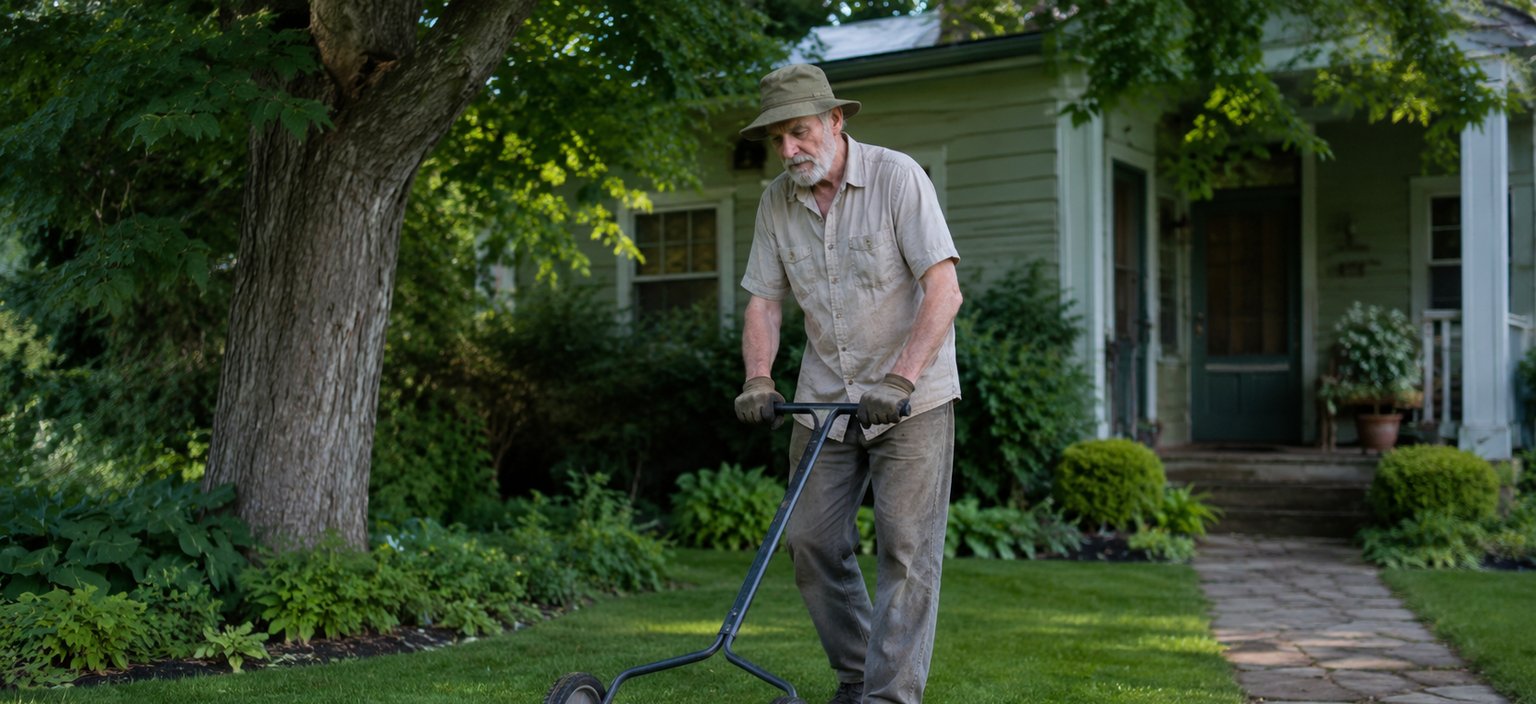
    A person mowing with a manual reel mower under a shade tree

    Mowing frequency

    Extension says bermuda home lawns should be mowed at least once per week. In peak season — May through August, with heat, humidity and nitrogen all working — twice a week is not unreasonable if you want to hold a low height without violating the one-third rule.

    Zoysia does not need mowing as often as bermuda. Centipede is slower still. That is a real part of the maintenance calculation when choosing a grass.

    Details worth getting right

    Keep the blade sharp. A dull rotary blade tears rather than cuts. The ragged tips brown out within a day or two and give the whole lawn a grey cast, and the wounds are entry points for disease.

    Leave the clippings. They are mostly water, they break down quickly, and they return nitrogen. Clippings do not cause thatch — thatch is built from stems, stolons and roots. The exception is the spring scalp, where you are removing dead material and should bag it.

    Watch the thatch layer anyway. Extension’s April calendar says to dethatch bermuda and zoysia if the layer exceeds half an inch, and to wait for active growth. Their Home Lawn Maintenance page uses a one-inch threshold. Either way, check it in spring rather than discovering it in July.

    Change direction. Mowing the same pattern every week trains the grass to lean and compacts the same wheel tracks.

    Do not mow wet grass if you can avoid it. It clumps, it cuts unevenly, and it spreads fungal disease around the yard on the deck and tires.

    Quick reference

    • Bermuda: 1.5 to 2 inches, weekly minimum, twice weekly in peak season
    • Zoysia: 1.5 to 2.5 inches, roughly weekly
    • Centipede: 1 to 2 inches, every 7 to 10 days
    • St. Augustine: 3 to 4 inches, weekly
    • Never remove more than one third of the blade in one pass
    • Sharpen the blade at least twice a season
  • Best Grass for Tuscaloosa Lawns: Top 4 Compared

    Best Grass for Tuscaloosa Lawns: Top 4 Compared

    Pick the wrong grass in Tuscaloosa and no amount of fertilizer, water or effort fixes it. Pick the right one and the lawn mostly takes care of itself.

    The complication is that Tuscaloosa sits on a boundary. Alabama Extension writes separate recommendations for north, central and south Alabama, and Tuscaloosa lands near the edge of several of them. Two of the four common warm-season grasses are, by Extension’s own language, marginal here.

    The four candidates

    Bermudagrass

    The default lawn grass across Alabama, and the only one of the four that Extension describes as adapted statewide.

    • Mowing height: 1 to 2 inches per Extension’s Home Lawn Maintenance table. Their dedicated bermudagrass guide says 1.5 to 2.5 inches for home lawns and at least weekly mowing.
    • Sun: Full. Extension notes that even a little shade produces a thinner stand.
    • Water: 1 to 1.25 inches per week, more during persistent drought.
    • Nitrogen: 3 lb per 1,000 sq ft per year standard, 5 lb maximum.
    • Establishment: Sod, sprigs or seed depending on variety. Hybrids like Tifway 419 are sod or sprig only. Seeded types include Riviera, Sahara and Princess 77.

    Bermuda recovers from damage faster than anything else on this list. That matters if you have dogs, kids, or a lawn that takes real traffic. The cost is frequency — it needs mowing more often than the others and it will not tolerate shade.

    Zoysiagrass

    The compromise choice. Denser and slower-growing than bermuda, more shade tolerant, considerably slower to recover.

    • Mowing height: 1 to 2 inches (Home Lawn Maintenance table); the zoysia guide says 1.5 to 3 inches.
    • Sun: More shade tolerant than bermuda, but Extension pushes back directly on the idea that zoysia is a shade grass. It still prefers full sun.
    • Water: About one inch of supplemental irrigation during dry spells.
    • Nitrogen: 2 lb standard, 3 lb maximum.
    • Establishment: Usually sod for wide-bladed cultivars like Meyer and Empire. Zenith is a common seeded option.

    The honest tradeoff: zoysia needs mowing less often than bermuda, but when it gets damaged — traffic, disease, dogs — it takes a long time to come back. Extension flags slow recovery repeatedly.

    Centipedegrass

    Extension calls it “the workhorse of warm-season turfgrasses.” Lowest input requirement of the four by a wide margin.

    • Mowing height: 1 to 2 inches (Home Lawn Maintenance table); the older ANR-0073 publication says 1 to 1.5 inches.
    • Sun: More shade tolerant than bermuda, less than St. Augustine or zoysia. Still needs six-plus hours of direct sun.
    • Water: About one inch per week to hold color.
    • Nitrogen: 1 lb standard, 2 lb maximum — and this is the one to take seriously. Extension warns that too much nitrogen actually suppresses centipede growth.
    • Soil pH: Prefers it acidic, around 5.5, and tolerates 5.0 to 6.0. That suits Tuscaloosa’s naturally acidic soils well.
    • Establishment: Seed or vegetative. Seed at a quarter to half a pound per 1,000 sq ft, best planted April through July.

    The catch: Extension recommends centipede for central and south Alabama and describes it as not as cold tolerant as bermuda or zoysia. Tuscaloosa is inside that recommendation, but not deep inside it. A hard winter is a real risk.

    St. Augustinegrass

    The most shade tolerant of the four, and the most questionable choice for Tuscaloosa.

    • Mowing height: 2.5 to 4 inches — much taller than the others. Older varieties want 3 to 4 inches, newer lower-growing ones 2 to 3.
    • Sun: The best shade performer here. Extension says it can produce a lawn in shady areas for a few years.
    • Water: Roughly half an inch per application, early morning.
    • Nitrogen: 2 lb standard, 4 lb maximum.
    • Establishment: Vegetative only — sprigs, plugs or sod, with sod recommended. Best window is May through August, watered daily for at least two weeks after planting.

    The catch, and it is a big one: Alabama Extension limits St. Augustine to the southern half of the state due to poor cold tolerance. Tuscaloosa is at or just past the northern edge of that recommendation. St. Augustine is also the grass most vulnerable to chinch bugs, which Extension calls its most serious insect pest.

    What about fescue?

    Tall fescue is the cool-season grass people reach for when they have heavy shade. In Tuscaloosa it is a bad bet.

    Extension states that north Alabama is the southern limit of tall fescue’s zone of adaptation and is considered the transition zone. Tuscaloosa is south of that line. Extension adds that fescue will experience heat stress and may go semi-dormant mid-summer, and that in especially hot summers fescue lawns “will suffer considerable damage and become thin and patchy.”

    With July normals of 92 degrees by day and 71 at night here, that describes an average Tuscaloosa summer, not an unusual one. If you have shade deep enough that no warm-season grass works, the honest answer is usually a shade bed, mulch or groundcover rather than fescue.

    Side by side

    GrassMowing heightShadeAnnual N (lb per 1,000 sq ft)Tuscaloosa fit
    Bermudagrass1 to 2 in.Poor3 standard, 5 maxAdapted statewide
    Zoysiagrass1 to 2 in.Moderate2 standard, 3 maxGood
    Centipedegrass1 to 2 in.Moderate1 standard, 2 maxCentral and south AL; near the edge
    St. Augustinegrass2.5 to 4 in.Best2 standard, 4 maxSouthern half of state only; marginal here

    Mowing heights are from Extension’s Home Lawn Maintenance Table 1. Species-specific Extension guides publish slightly different ranges — that is Extension’s inconsistency, not a typo.

    Extension’s shade ranking, in their own words: St. Augustine and zoysia are more shade tolerant than centipede, which is more tolerant than bermuda.

    One thing you will see in a lot of lawn articles that is not in Alabama Extension’s materials: a tidy drought-tolerance comparison table. They do not publish one. Extension says centipede has good drought tolerance and that bermuda may need extra water in persistent drought, and says nothing usable about zoysia. Be skeptical of anyone presenting a four-way drought ranking as Extension guidance.

    How to actually choose

    Walk the yard and count hours of direct summer sun.

    • Six-plus hours, heavy use, want it to bounce back: bermuda.
    • Six-plus hours, want less mowing, willing to baby it after damage: zoysia.
    • Six-plus hours, want the least work and lowest input: centipede, accepting some winter risk.
    • Four to six hours: zoysia, or reconsider what is casting the shade.
    • Under four hours: no warm-season grass will hold. Prune to let light in, or plant something that is not turf.

    Before you buy sod for a whole yard, get a soil test. Tuscaloosa County soils are typically acidic and low in nutrients, and pH correction is far cheaper before the sod goes down than after.

  • Tuscaloosa Lawn Care Calendar: Month-by-Month Guide

    Tuscaloosa Lawn Care Calendar: Month-by-Month Guide

    Tuscaloosa is an awkward place to look up lawn advice. Half the guides you find are written for the Gulf Coast and half are written for Tennessee, and Tuscaloosa sits squarely between them. On the 2023 USDA Plant Hardiness Zone Map the city is split: the 35401 ZIP falls in Zone 8b, while 35406 to the north is 8a. That line runs through town, and it is a decent metaphor for how turf recommendations work here.

    This calendar leans on the Alabama Cooperative Extension System — Auburn’s extension service, the closest thing we have to a local authority — plus NOAA climate normals for the Tuscaloosa Municipal Airport station. Where Extension only publishes guidance for “south Alabama,” that is noted, because Tuscaloosa is not south Alabama.

    The climate you are actually working with

    Two numbers shape almost everything below.

    The first is frost. Using NOAA’s 1991 to 2020 normals for Tuscaloosa Municipal Airport, the 50 percent probability date for the last spring freeze is March 24, and the first fall freeze is November 10. Those are coin-flip dates, not guarantees. The Alabama State Climatologist’s office notes that the latest recorded last freeze at this station was April 21, back in 1953.

    The second is rainfall, and it is the one most people get wrong. Tuscaloosa averages 52.60 inches a year, which sounds like plenty. But look at the distribution:

    MonthNormal precipitation (in.)
    Jan5.35
    Feb5.32
    Mar4.54
    Apr4.21
    May3.98
    Jun4.77
    Jul4.40
    Aug3.30
    Sep3.52
    Oct3.51

    August, September and October are the three driest months of the year. That is precisely when warm-season grass is still actively growing and when irrigation demand peaks. The wettest months are November through February, when the lawn is dormant and does not care.

    January and February

    Nothing is growing. This is planning season.

    Get a soil test done now, before the spring rush. Alabama Extension routes samples through the Auburn University Soil, Forage and Water Testing Laboratory. A routine analysis covers pH, phosphorus, potassium, magnesium and calcium. For an established lawn, sample the top 2 to 3 inches and composite subsamples from at least ten spots. The published fee was $10 per sample as of the 2022 schedule — confirm current pricing with the lab before you mail anything. The Tuscaloosa County Extension Office at 1800 McFarland Blvd E is the local contact point.

    If lime is called for, this is the window to apply it. Coastal Plain soils across most of Tuscaloosa County run acidic, typically below pH 6.0, and lime takes months to move.

    February is also the backup window for pre-emergent herbicide. Extension’s guidance: “Apply preemergent herbicides if forgotten in September and if spring weeds were a concern last year.” The primary window was last fall.

    March

    Average last freeze is March 24. Growth begins but is not reliable yet.

    If you are going to scalp — dropping the mower deck progressively to remove dead top growth before green-up — Extension describes the approach as lowering the deck one notch a month and bagging clippings, aiming to be at your lowest setting by the time the grass wakes up.

    Do not fertilize yet. Extension is explicit that fertilizing warm-season turf too early in spring reduces root mass.

    April

    Green-up month. Extension’s April calendar says to start a mowing routine as spring growth begins and to fertilize warm-season lawns after they are fully green — not at the first hint of color.

    Also in April:

    • Check thatch on bermuda and zoysia. Extension’s April calendar sets the dethatching threshold at half an inch and says to wait for active growth. (Their Home Lawn Maintenance page uses one inch. Pick a threshold and know which one you are following.)
    • Watch for fungal disease in cool, wet weather.
    • Do not spray post-emergent herbicide during spring transition. Extension’s chemical weed control guide says plainly: do not apply during green-up, when the lawn is emerging from dormancy and least able to take the hit.

    May and June

    The lawn is growing hard. This is when it wants nitrogen.

    Never apply more than one pound of nitrogen per 1,000 square feet in a single application. Annual totals from Extension’s Home Lawn Maintenance table, in pounds of N per 1,000 square feet per year (standard / maximum):

    GrassStandardMaximum
    Bermudagrass35
    Zoysiagrass23
    St. Augustinegrass24
    Centipedegrass12

    Centipede is the one people ruin. Too much nitrogen actively suppresses it.

    May through June is also the peak hatch window for mole crickets — Extension puts it at early May to mid-June — and treatments aimed at young nymphs in June, July and early August work far better than anything applied later.

    July and August

    Heat. July normals for Tuscaloosa are a 92.1 degree high and a 71.3 degree low. Overnight lows above 70 mean the turf never really cools off and recovers.

    Water deeply and infrequently. Extension’s guidance is to apply half an inch to one inch per application, enough to wet the soil 4 to 6 inches down, and to never water daily except during establishment. Frequent shallow watering builds shallow roots. Water early in the morning to limit evaporation loss. To calibrate, set a few empty tuna cans around the zone and time how long your system takes to fill them.

    Then there are armyworms. Extension notes that in most years, reports of fall armyworms on turf start in late July or early August. Well-fertilized bermuda is their favorite target. Scout with a soap flush — two tablespoons of dish soap in a gallon of water poured over a square foot or two — and treat while the caterpillars are under half an inch long. Extension maintains a county-by-county armyworm tracker that is worth bookmarking from July onward.

    September and October

    The most important month of the year for weed control is September, and almost nobody treats it that way.

    Extension’s fall guidance is to apply pre-emergent for winter and spring weeds in mid-September or early October. This is what stops annual bluegrass, henbit and chickweed from taking over in February. Note that Alabama Extension gives calendar dates, not soil temperature thresholds — the widely repeated “55 degree soil temperature” rule comes from UGA Extension, not Auburn.

    Early fall is also a reasonable core aeration window, though Extension contradicts itself here: Home Lawn Maintenance says summer, Fall and Winter Lawn Care says early fall, the south Alabama calendar says April. The safe underlying principle is to aerate while the grass is actively growing and has time to recover.

    If you overseed dormant bermuda with perennial ryegrass, September and October is the window, at 8 to 12 pounds per 1,000 square feet. Perennial ryegrass beats annual for texture, color and disease tolerance. Know going in that you will be fighting it back out again in late spring.

    Large patch fungicide, if you have a history of it, goes down in early fall before dormancy.

    November and December

    Growth stops. The lawn goes off-color and that is normal.

    Wild garlic and wild onion are best treated now — Extension’s window is November or December, then again in February.

    Keep leaves off the turf, apply lime if your soil test called for it, and resist the urge to fertilize. Late-fall nitrogen on warm-season grass increases the risk of winter injury.

    The short version

    If you do only four things a year in Tuscaloosa: soil test in winter, fertilize after full green-up in April, water deep and infrequent through the August-to-October dry stretch, and put down pre-emergent in mid-September. That sequence prevents more problems than everything else on this page combined.