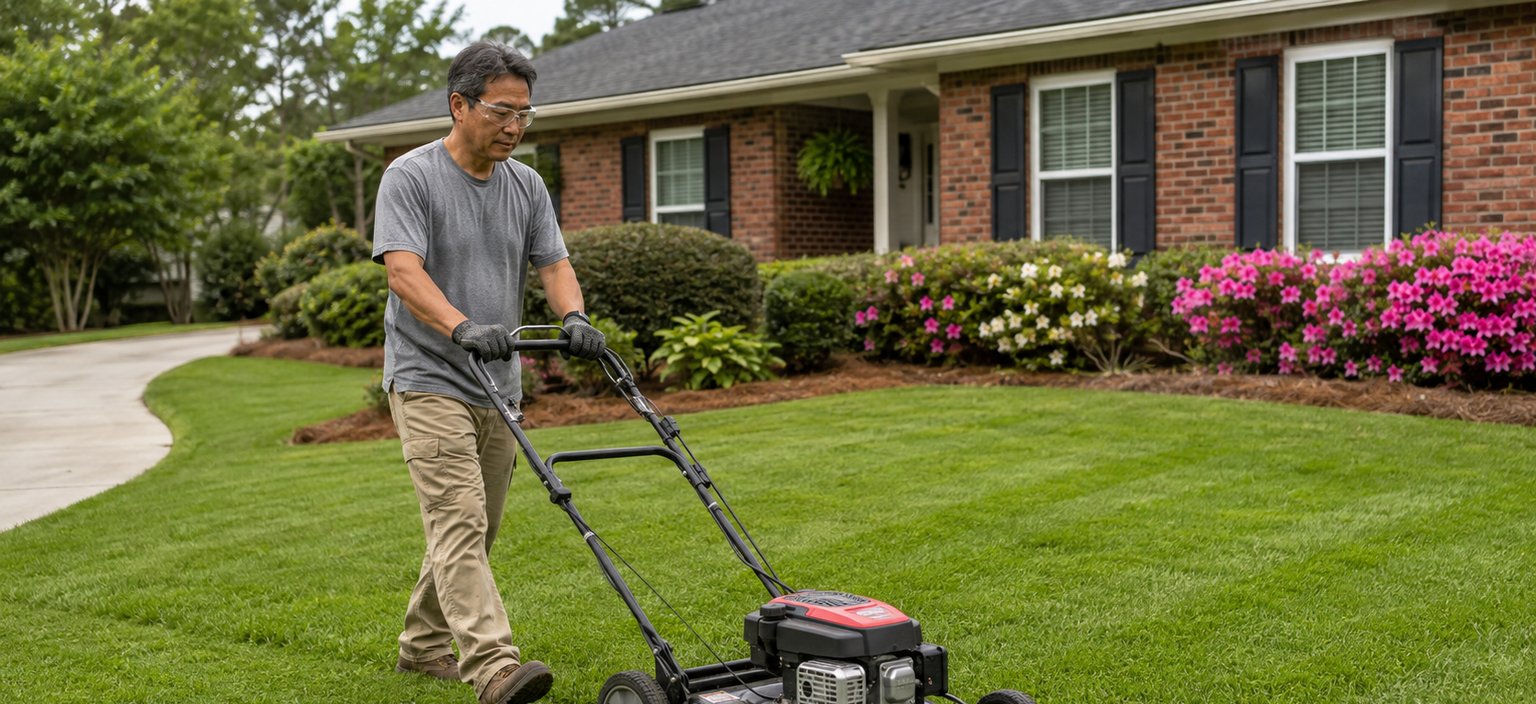
Mowing height is the single cheapest lever you have. It costs nothing, you already own the equipment, and getting it right prevents more weed and drought problems than any product you can buy.
Most Tuscaloosa lawns are cut too short.
Alabama Extension’s numbers
Extension’s Home Lawn Maintenance page publishes what amounts to the canonical table for Alabama:
| Grass | Recommended mowing height |
|---|---|
| Bermudagrass | 1 to 2 in. |
| Centipedegrass | 1 to 2 in. |
| Zoysiagrass | 1 to 2 in. |
| St. Augustinegrass | 2.5 to 4 in. |
| Tall fescue | 2 to 3.5 in. |
Worth knowing: Extension’s own species-specific guides publish somewhat different ranges. Their bermudagrass guide says 1.5 to 2.5 inches for home lawns. The zoysia guide says 1.5 to 3 inches. The older centipede publication says 1 to 1.5 inches. These are not typos, they are genuine inconsistencies across Extension publications written at different times.
Practical read: anywhere in the union of those ranges is defensible. The failure mode is not being an eighth of an inch off, it is cutting bermuda at three quarters of an inch with a rotary mower because a neighbor does.
The one-third rule, which matters more than the number
Extension states it plainly: “never remove or mow off more than one-third of the turfgrass height in any mowing event.”
This is the rule people break constantly, usually by skipping a week. If you maintain bermuda at 1.5 inches, you should be mowing when it hits about 2.25 inches. Let it reach 3 and cutting back to 1.5 removes half the plant at once.
What that does: the grass dumps root mass to rebalance with the reduced leaf area. Shallow roots mean less drought tolerance, which matters a great deal in a place where August, September and October are the three driest months of the year. It also opens the canopy and lets sunlight reach soil, which is exactly what germinating crabgrass wants.
Scalping a lawn once will not kill it. Scalping it every week all summer produces a thin, weedy, drought-prone lawn, and the owner usually concludes they need more fertilizer.
Why taller is usually better here
More leaf area means more photosynthesis, deeper roots, more shade at the soil surface. In Tuscaloosa’s summer — July normals of 92 degrees by day and 71 at night — that shading effect is doing real work. Bare soil between thin grass blades heats up, dries out and grows weeds.
The exceptions:
- Reel-mown bermuda. Extension notes bermuda can be maintained below half an inch with a reel mower. That is a legitimate maintenance system with its own fertility, irrigation and mowing-frequency requirements. It is not what a rotary mower on a suburban lot is doing.
- Spring scalping. Deliberately dropping the deck before green-up to remove dead thatch and let soil warm is a recognized practice. Extension describes lowering the deck one notch per month and bagging clippings, aiming to hit the lowest setting right as the grass comes out of dormancy. That is a once-a-year event, not a standing height.
Mowing frequency
Extension says bermuda home lawns should be mowed at least once per week. In peak season — May through August, with heat, humidity and nitrogen all working — twice a week is not unreasonable if you want to hold a low height without violating the one-third rule.
Zoysia does not need mowing as often as bermuda. Centipede is slower still. That is a real part of the maintenance calculation when choosing a grass.
Details worth getting right
Keep the blade sharp. A dull rotary blade tears rather than cuts. The ragged tips brown out within a day or two and give the whole lawn a grey cast, and the wounds are entry points for disease.
Leave the clippings. They are mostly water, they break down quickly, and they return nitrogen. Clippings do not cause thatch — thatch is built from stems, stolons and roots. The exception is the spring scalp, where you are removing dead material and should bag it.
Watch the thatch layer anyway. Extension’s April calendar says to dethatch bermuda and zoysia if the layer exceeds half an inch, and to wait for active growth. Their Home Lawn Maintenance page uses a one-inch threshold. Either way, check it in spring rather than discovering it in July.
Change direction. Mowing the same pattern every week trains the grass to lean and compacts the same wheel tracks.
Do not mow wet grass if you can avoid it. It clumps, it cuts unevenly, and it spreads fungal disease around the yard on the deck and tires.
Quick reference
- Bermuda: 1.5 to 2 inches, weekly minimum, twice weekly in peak season
- Zoysia: 1.5 to 2.5 inches, roughly weekly
- Centipede: 1 to 2 inches, every 7 to 10 days
- St. Augustine: 3 to 4 inches, weekly
- Never remove more than one third of the blade in one pass
- Sharpen the blade at least twice a season